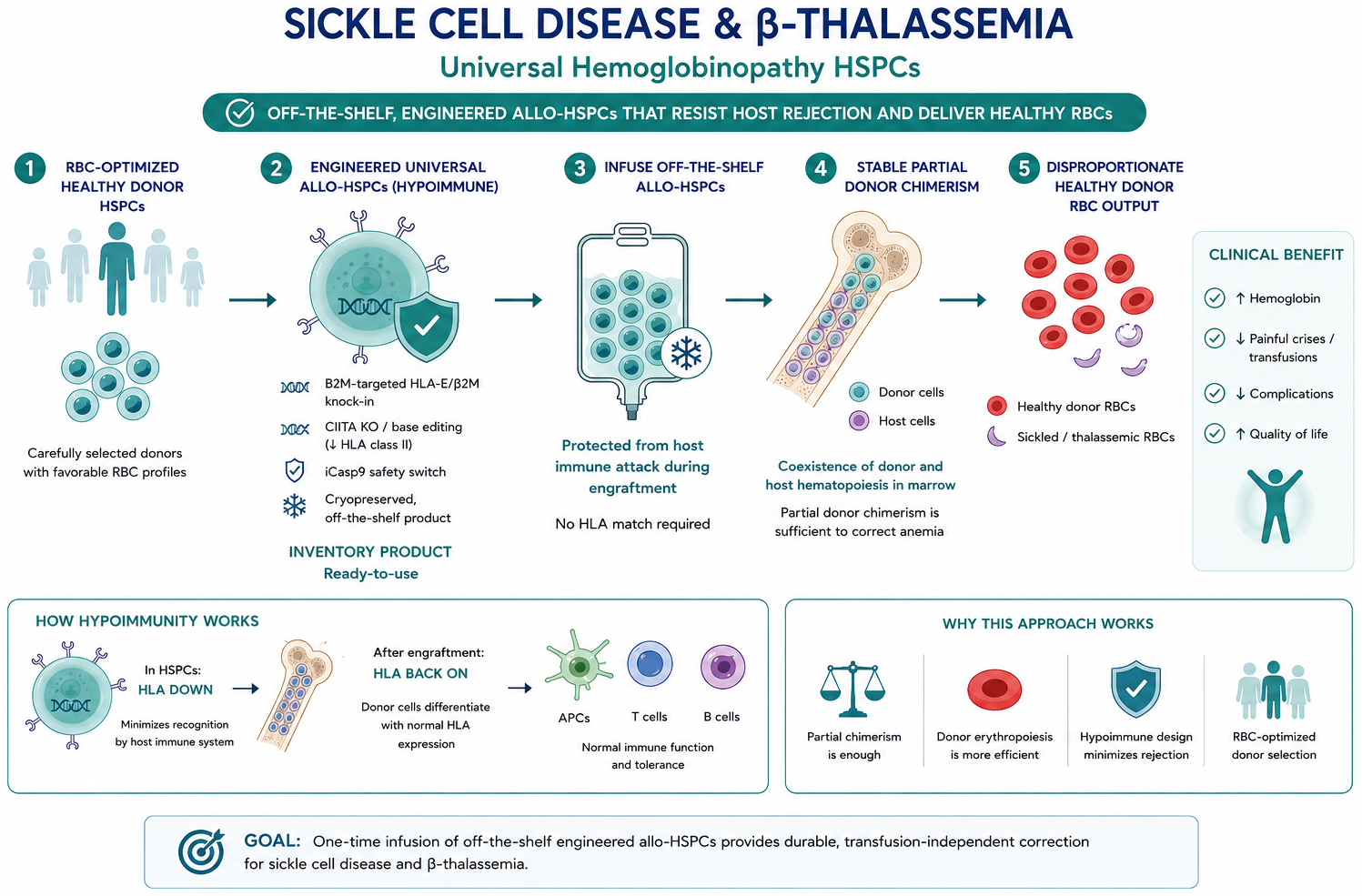
Partial donor chimerism, disproportionate healthy red cell output.
In sickle cell disease, roughly 20–25% donor myeloid chimerism can be enough to sustain a non-sickling phenotype. In β-thalassemia, donor red cells can likewise become disproportionately enriched. A banked product does not have to fully replace the marrow to change the disease.
Curative biology exists. Access does not.
Donor availability, manufacturing capacity, cost and treatment-centre access limit global reach — so the overwhelming majority of patients have received neither transplant nor gene therapy.
Sickle cell disease
β-thalassemia
Sources & caveats
Global transfusion-dependent thalassemia estimates vary by source and region; a commonly cited range is 60,000–200,000.
WHO / CDC (SCD prevalence); Thalassemia International Federation; CIBMTR / EBMT literature; public company disclosures for gene therapy uptake.
A banked, one-time infusion — no donor search.
A Middle East–first development wedge.
Cell & gene therapy IND path, with global clinical development and regional access strategy.
Stable donor chimerism · donor red cell / erythroid output · conditioning, durability and safety.
Regional collaborations in the Middle East, where prevalence is high, then global markets.
Regulatory routes shown are planning hypotheses, not approval claims.