One editing toolbox under all three pillars.
Site-specific knock-in at a locus we choose, characterized in primary human cells — the shared engineering foundation beneath the banked donor products, the autologous tolerance work, and ECEP.
One engineering foundation, three pillars.
The same editing approach is tuned differently in each pillar — donor cells engineered for acceptance, a patient's own cells engineered for tolerance, and a manufacturing concept to deliver either at the bedside.
Off-the-shelf
Donor HSPCs tuned along two axes — how the cells stay invisible, and how long the graft should last.
Pillar 01 →Autologous
The patient's own HSCs engineered to educate their immune system — tolerance rather than invisibility.
Pillar 02 →ECEP
A closed, automated concept for running the same engineering at the point of care.
Pillar 03 →Site-specific knock-in, not semi-random integration.
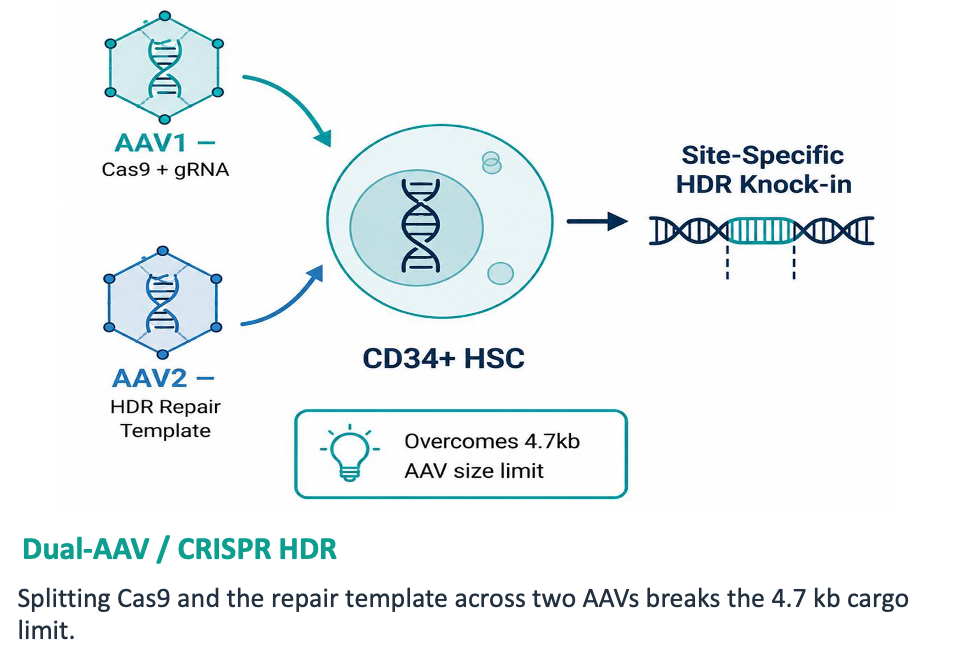
Homology-directed repair puts the cassette at a locus we choose — with known copy number and endogenous regulation intact.
Approved lentiviral products integrate semi-randomly: variable copy number and expression, and an insertional-mutagenesis risk that has to be monitored for years.
Splitting the nuclease and the repair template across two vectors breaks the single-vector packaging limit, so a full cassette can be delivered.
Immune compatibility and safety are tuned per indication by which of these are engineered, and how. Construct-level design and preclinical data are available under CDA / NDA.
Measured, not assumed.
Each editing configuration is characterized for on-target integration, expression and immune phenotype before it enters a program. All programs are preclinical.
Manufacturing is the next constraint.
ECEP is Hemavive's closed, automated concept for bringing engineering closer to the patient.